Showing posts with label musicology. Show all posts

11 June 2014

The (other) Tournai Mass

[This is a draft “Working Paper” of research in progress; comments are welcome, but it should not be considered published work and may be removed before this is submitted for publication and replaced with a link to the published version.] 

The Tournai Mass is one of the oldest, if not the oldest, complete polyphonic Masses. It has been dated to around 1330 (though I'm inclined to find it a bit younger, perhaps 1350? but just on a hunch). It is contained in a magnificently interesting manuscript of chant from the fourteenth century now in the Belgium city of Tournai (Bibliothèque capitulaire, MS 476).

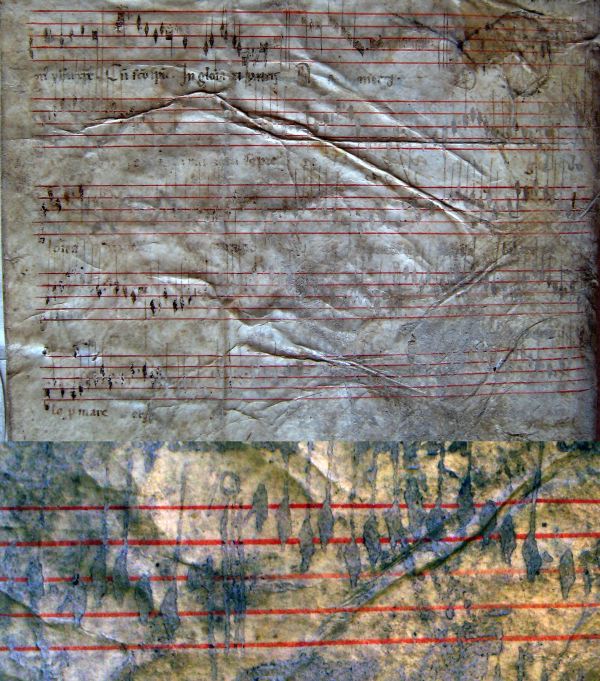
Like some other early Masses, such as the Machaut Mass, this is a six-section Mass with a concluding Ite Missa Est set as a motet. There are two other polyphonic works in the manuscript, placed within the Mass, a largely monophonic Sanctus with three-part "In excelsis" settings (PMFC 23, no. 72), directly after the first Sanctus, and a second Kyrie, placed after the Agnus Dei. The image from the bottom of folio 33r is below:


(image reproduced under the assumption of limited copyright of works over 100 years old and under the Fair Use principle of a small excerpt. I will happily remove this and the following excerpt under a request from the Tournai BC)

In Reaney's notes for RISM B/IV-2, he states that this work (#7) is, like the Sanctus (#5), an independent, polyphonic Mass section and transcribes the incipit as such:


Cattin and Facchin in their monumental edition of French (& Spanish, Polish, Dutch, ... everything but Italian and English) Mass movements transcribed it as monophonic and noted that:
The well known melody...occurs in the T[enor] range in the Tournai MS; the question therefore remains whether one or more voices would have accompanied it. For this reason we decided to include this purely monodic piece in the present edition.
The opening of their transcription is shown below:

There are a few errors in this section of the transcription: the second Kyrie has three missing notes, and an incorrectly transcribed C instead of D. Together these errors account for the different lengths and incompatible harmony of the first Kyrie if the work were to be transcribed polyphonically, as I will propose below. There are a few length errors in the third Kyrie which also could have made a polyphonic transcription difficult. However it is the Christe section that I am sure made great editors who had 130+ mass movements give up on making a polyphonic 3-fold Kyrie and instead make a monophonic 9-fold Kyrie. The three Christe sections seem to begin on the notes A, G, and A and end on A, E, B; even if the first part is started after a breve rest (which may be interpreted as a sectional divider instead), the lengths and sonorities of this section just do not add up.

The solution comes from believing that the scribe himself did not realize where the different voices began and chose to ligate the final note of the first voice with the first note of the second voice.

Beginning the second part on the second note of the ligature and ending the first voice on the first part gives a fully satisfying polyphonic version of the whole Kyrie:


A mediocre, generated .mp3 giving some sense of the piece is given below.


With these adjustments, the piece is almost entirely consonant, with the following breakdown of sonorities (discounting triplets in the middle of a semibreve):

36%  Perfect fifth
18   Major triad
12   Major third
12   Minor triad
 9   Minor third
 8   Minor triad as 6-3
 3   Major sixth
 2   Minor sixth
 0.5 Perfect fourth

(Numbers do not add up to 100% because of rounding)

Cattin and Facchin note that piece seems to be on the chant cantus firmus of no. 58 of Margaretha Landwehr-Melnicki's catalogue. The first Kyrie is indeed similar to this chant, but as a look at Paris, BNF lat. 14819, f. 34v. or Paris, BNF lat. 17309, f. 27v will show, the rest of the work is unrelated to this chant.

Otherwise the style of the work is similar to many French works from around 1350 (and also Spanish and Italian works from this time or slightly later). Facchin's description of these pieces, largely homophonic but with decorations, as part of a Wandering Style, or Stile Vaganti! seems quite appropriate for this work that wandered around the foot of a more famous Mass, waiting to be rediscovered.

More about the Sanctus and a fuller realization of it to come soon, thanks to an idea from Jan Janovčik. Here's a preview of his great recording with his Cantores Sancti Gregorii


Thanks to Jan Janovčik, Rob C. Wegman, and Dominique Gatté for aid and suggesting the Tournai manuscript as a source worth returning to. And to Anna Grau and Jeremy Jennings for their work on the EMMSAP project that made this work quickly possible.

28 May 2014

Conference/Journal Convergence

The latest issue of Journal of Musicology just appeared (in virtual form) for me today, and I've been reading through the fascinating articles by Karol Berger and Michael Gallope this morning (I omit Peter Schmelz's contribution not because I don't think it's fascinating, but simply because I haven't gotten to it at the time of writing). On broad topics cutting across decades and centuries, these are the types of articles that I wish appeared more often in my field. The arrival of this issue has made me set aside (again in a metaphorical sense) the journal that I had been reading through with interest, Gamut, a recently reestablished and exciting music theory journals that publishes entirely online.

Unifying the issues of these two quite different journals, and many of the other publications I've read recently, is that the articles selected for publication came not through open calls for submissions but as proceedings of conferences or as designed Festschriften for a major figure (well, important man, to be technical) in the field.

Yard from Dguendel/WP (CC:BY) 
Sign from arkadin55(CC:BY-NC-SA)
The JM issue comprises papers from the 2012 conference in honor of Richard Taruskin, "After the End of Music History," which included talks by so many of the brightest stars in the musicological firmament and which was covered in the New York Times. James Steichen's introduction to this and the following issue, which will contain more papers from the same conference, helps those of us who were not there feel the energy of the weekend: the dual performances of a lost Eugene Onegin, the premiere of a new work, the evenings on at a club at Princeton.

Beyond placing these articles together within the cultural context that produced them, what musicologists usually aspire to do with their writings on musical works, there is much that is gained from publishing articles from a single conference together. Responses from the audience or the dedicatee can be transcribed, edited, and included (the old IMS reports are fascinating in this regard). Interconnections among papers can be made by the writers themselves. And there is the opportunity, which Karol Berger takes, to keep articles shorter, nearer the length of the original presentation. This facet alone makes publication of conference proceedings and Festschriften in journals worth advocating. Too many of our journals contain articles that are far too long for their topics or narrow audiences. Whether encouraging such length is the editors' intent, or indeed even if they continue to publicly solicit shorter articles, those students and scholars who want to be published look at the tomes that do get accepted and are smart enough to know what to do.

Conferences as journal issues mitigate against this trend. They also help scholars, especially the untenured or underemployed, stay active in the vital intellectual life of the field by attending meetings and not needing to decide whether they will contribute their work to a special conference proceeding book, which will likely count less for tenure no matter how selective the press or how strong the process of peer review, or go out on their own in search of a peer reviewed journal.

Yet I am uneasy about the implications as more and more space in journals, especially at the top journals, becomes devoted to conference papers, or to colloquies, symposia, and round tables (common now in the Journal of the American Musicological Society). Conferences turn into journal issues either by the editors of the journal seeking out conferences or selected papers from conferences to publish or by the organizers of the conference proposing their papers (or, again, a subset) as ripe fruit for an issue. In either case, the scholars who are or could be included come from the group of people invited to present at the conference. Many conferences begin with an open call for papers, but these are rarely the conferences that turn into journal issues. Journal paper selection moves from selecting articles from the broad scholarly public to the group of people who were invited to prestigious conferences. And these invitations rarely, if ever, go out on the basis of the work to be spoken of at the conference--which is almost never written at the time of the invitation--but on the basis of past work.

This development does not harm me personally. I am now at a stage of my career where I receive more invitations to speak at important meetings in traditional and computational musicology than I could attend, let alone write new contributions for. And my newly tenured state enables me to publish more in fora that seem appropriate (even blog posts) than worry about what a promotion committee will think of the surrounding context of my thoughts. The change to conferences as journals does, however, have the potential, especially if it becomes more common, to exclude from publishing those who are less well-connected, who are not invited to be in colloquies or symposia, but who have thought-provoking and well researched ideas. The organizers of "Taruskinfest" and the JM editors are to be commended (and nothing here is directly specifically against them) for including younger scholars in their celebration and publications, but not every conference journal issue, especially Festschrift contributions, are so thoughtful.

The change also has the effect of squeezing out space for ideas and areas of work that are at present too obscure or new to be the subject of a conference or for interpretations that go sharply against those of the senior scholars who are in the position to convene these events. Musicology, and I suspect many other humanistic disciplines, is not yet at a post-publication, post-peer-reviewed-journal state; any changes that may make it harder for the brightest and newest of ideas to be shared in our journals should proceed cautiously and under the scrutiny of the field.

23 May 2014

Web Pages with musical examples...

Through the music21 Javascript port, music21j, any webpage can now include (simple) musical examples easily. Copy and paste the following code somewhere in the webpage:

<script>
window.m21conf = { loadSoundfont: false };
</script>
<script src="https://cdn.jsdelivr.net/npm/music21j@0.20.1/releases/music21.debug.min.js"></script>
<link href="https://cdn.jsdelivr.net/npm/music21j@0.20.1/releases/music21j.min.css" rel="stylesheet"> <script>
music21.common.urls.soundfontUrl = 'https://raw.githubusercontent.com/gleitz/midi-js-soundfonts/gh-pages/FluidR3_GM/';
music21.miditools.loadSoundfont('acoustic_grand_piano');
</script>


If you are writing on Blogger or another platform, you will need to switch from "Compose" to "HTML" mode to enter this tag and the div tags below below. I wrote the rest of this post in Compose mode and then added the tags later. If you're an advanced user, you can put the script tag in your Blogger template. It will call the scripts asynchronously, so your page loading will not slow down.

This paragraph is no longer needed. The "data-main" parameter says that music21j is needed, and music21j uses the amazing require.js package, specified in the "src" parameter. Music21j uses new technologies that have been standard in all web browsers released since March 2011. Unfortunately, 20% of people on the Internet still use older browsers. If musical examples are crucial to your page, remove the warnBanner='no' line and a warning message and opportunity to upgrade the browser will be shown. For most of us, a page without examples is better than no page at all, hence why I suggest putting the warnBanner='no' line.

To put in a musical example, put the notation in the TinyNotation format described at moduleTinyNotation inside a tag with classes "music21" and "tinyNotation", like so:

<div class="music21 tinyNotation"> 2/4 c2 d e4 f#8. g16 r4 c'4</div>

The "2/4" is, obviously, the time signature. Notes are given by A-G for bass clef notes, a-g for low treble clef notes, a'-g' for higher treble clef notes, AA-GG for lower bass clef notes. Additional quotes or doubled letters represent even higher or lower notes.  #, b, or n are for sharp, flat, or natural (optional) and follow any quote signs.   "r" stands for a rest.

Durations are specified with 4 = quarter, 2 = half, 1 = whole, 8 = eighth, etc. A dot after the number dots the note.  There aren't ways of doing triplets, etc. currently.  If there is no number then the previous duration still applies.

Here is that example rendered.  Click on it to play it.

2/4 c2 d e4 f#8. g16 r4 c'4
There is no way of specifying the tempo, unfortunately. If you don't like the playback, put "noPlayback" in the class tags. For instance, the following example will not be played:

<div class="music21 tinyNotation noPlayback">3/4 C2 D-4 Dn E- E F2.</div>
3/4 C2 D-4 Dn E- E F2.

I'm working on getting other notation formats, including MusicXML, ABC, MIDI, etc. to work soon; however they will not be converted on the browser, so only TinyNotation will work on a completely off-line application.  This summer will see some amazing new developments in this space.

The rendering is done via VexFlow and the playback is from MIDI.js. Both are amazing projects worthy of supporting. The development of music21j is supported by a Brit D'Arbeloff education grant at MIT.

Updated January 2026: Replaced the previous instructions with ones that work:
<script data-main="http://web.mit.edu/music21/music21j/src/music21"
        src='http://web.mit.edu/music21/music21j/ext/require/require.js'
        warnBanner='no'></script>

09 July 2012

Fuga Trium Tempora from the Strasbourg Codex

[This is a draft “Working Paper” of research in progress; comments are welcome, but it should not be considered published work and may be removed before this is submitted for publication and replaced with a link to the published version.]

The manuscript, Strasbourg, Bibliothèque Municipale (olim Bibliothèque de la Ville), MS 222. C.22, was an extraordinary collection of music theory and secular and sacred music (sometimes in contrafact) from the first half of the fifteenth century.  In 1870, during the siege of Strasbourg in the Franco-Prussian war, the manuscript was destroyed.  Fortunately, portions of the manuscript survive in two important testimonies from before 1870: a short publication by Auguste Lippmann, “Essai sur un manuscrit du quinzième siècle decouvert dans la Bibliothèque de la ville de Strasbourg” Bulletins de la Société pour la Conservation des Monuments Historiques d'Alsace Serie 2.7 (1870), pp. 73–76, which reproduces a single page of the manuscript in facsimile (see Figure 1 below) and a partial copy of the manuscript made by Edmond de Coussemaker.  Coussemaker copied the table of contents, made an index with incipits, and transcribed some, but not all, of the pieces in the manuscript.  Coussemaker’s copy is now Brussels, Bibliothèque du Conservatoire Royal de Musique, MS 56.286 and has been published in facsimile in Albert van der Linden, editor, Le manuscrit musical M.222 C.22 de la Bibliothèque de Strasbourg: XVe siècle (Brussels: Office international de librairie, 1977). Many of the works in the manuscript can be identified through concordances in other manuscripts, though the process of finding concordances through incipits with contrafacted sacred texts has not always been easy.  Important work on the manuscript was conducted by Charles van den Borren (Le manuscrit musical M.222 C.22 de la Bibliothèque de Strasbourg (XVe siècle) brulé en 1870, et reconstitué d’après une copie partielle d’Edmond de Coussemaker [Antwerp: E. Secelle, 1924]) and in an excellent Habilitationschrift by Lorenz Welker (“Musik im Oberrhein im späten Mittelalter: Die Handschrift Strasbourg, olim Bibliothèque de la Ville, C.22” [Habilitationsschrift: Basel, 1993]).  Though most of the music that Coussemaker transcribed has appeared in modern editions, a few pieces have never been published in modern notation.

 Figure 1: Color image of folio 78v from the Strasbourg codex

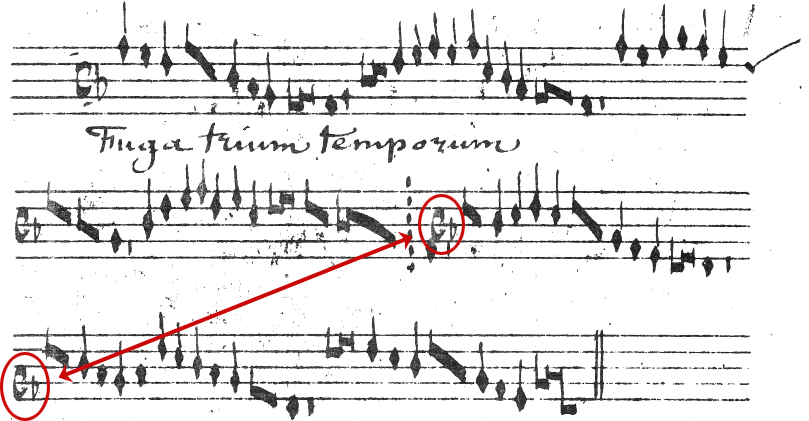
One such neglected work was found on folio 38r (or perhaps 37v–38r, see Welker, “Folio-Synopse” p. 12) and transcribed on pp. 32–33 in Coussemaker’s edition.  It is a “Fuga trium temporum” whose top voices are attributed to J. de Climen and whose tenor is attributed to J. Cornelius (“Tenor J. Cornelii”).  The double attribution is unusual but as Virginia Newes notes, the tenor is inessential to the canon and could have been added later. (“Fuga and related contrapuntal procedures in European polyphony ca. 1350–ca. 1420,” [Ph.D. dissertation: Brandeis University, 1987], p. 403).  The description “Fuga trium temporum” implies a canon at the unison separated by three breves.  That the title appears under the top voice suggests that it is the top two voices which are in canon.  Though tenor canons are not unusual in the period and for much of the piece the tenor works in canon with itself at the distance of three breves, this effect is largely accounted for by the tenor’s need to support the upper-voice canon, and several cases of bare perfect fourths and long passages in parallel unisons strongly argues against an intention of four-voice performance (which is what Ensemble Leones, the only group I have found that has performed the piece, did in their reconstruction of “[Quatour voces in] fuga trium temporum”) or of one upper voice plus two tenor voices in canon (which would not fit the idea that J. Cornelius added an additional voice to an existing fuga).  Reproductions of Coussemaker’s transcription of the work are in Figures 2 and 3.


Figure 2: Top voice of J. de Climen, Fuga trium tempora.
 

Figure 3: Tenor by J. Cornelius of Fuga trium tempora.

The two-part form of the piece suggests that the work may have originally been a rondeau that no longer has a text (similar to Baude Cordier’s Tout par compas).  Less likely, the piece could have been a virelai or even a ballata (like Andrea da Firenze’s Dal traditor in the Squarcialupi codex), though the close spacing between entrances is more characteristic of French than Italian superius canons.  In any case, Charles van den Borren’s suggestion (p. 88) that the work could be an Italian caccia seems unlikely.

The work’s neglect in modern scholarship may be due to its lack of text, but is more likely attributable to the unsatisfactory nature of the piece which results when transcribed from Coussemaker’s edition.  Whether read as two upper voices without tenor, two upper voices with tenor, or a single upper voice, several problems emerge. The top voices have an unusual phrygian cadence.  The piece ends with a major third (C–E) between the top voice(s) and tenor: highly unlikely for the period.  Several intense dissonances appear in the second section that are out of style with the first. Parallel octaves, fifths, and unisons the tenor and the upper voices appear six times (10 if closely syncopated parallels are counted) in the second half; they are absent in either counting in the first half. Finally, the top voices have no motivic repetitions between the first and second sections.  Example 1 transcribes the ending as written.


Example 1: Ending of Fuga trium tempora as transcribed.

A small emendation to the piece, not previously explored, relieves all five of these problems.  After the first note of the second section, the top voice should be read a third higher than it is written.  Either the scribe of the Strasbourg codex or Coussemaker either wrote this section a third too high or he neglected to notice a change of clef for the second half of the piece.  A proposed emendation of the top voice is given in Figure 4.


Figure 4: Proposed emendation to Coussemaker’s transcription.

With this emendation, the second half of the top voice echoes many elements of the first half, all parallels are removed, the ranges of the first and second half become identical, and the piece ends with the upper voices on G supported by the C a perfect fifth below in the added tenor part.  (If the tenor was essential and conceived with the upper voices, we might expect the top voices to end on a high G with the D a fifth below with the tenor singing the G a fifth below.  The change in modal flavor added by the tenor is further evidence of it being a later addition).  The whole piece as I have transcribed it is given in Example 2 and, for the sake of understanding the piece better, a MIDI rendition as an .mp3 file is given in Example 3.  After the middle cadence, the second upper voice may rest or continue the canon from the first section; examples supporting both types of continuation are found in other pieces in Newes’s dissertation.


Example 2: Fuga trium temporum, new transcription.

Example 3: MIDI rendition.

The new transcription does nothing to explain who J. de Climen or Johannes Cornelius might be.  David Fallows has proposed that he might be the same as Jacobus de Clibano known from several compositions in the Aosta codex (“Jacobus de Clibano,” s.v. in The New Grove Dictionary of Music and Musicians, 2nd edition) or, less likely, he may be the same as Clement Liebert known from the piece Comment porray in the Strasbourg codex.  But neither this short contribution nor the musical style of Comment porray (though also in 2/4 but in white notation) give any aid in confirming or refuting this connection.  But I hope that the addition of a new contribution to the small repertory of fugae and canons of the early quattrocento can give a renewed urgency in discovering more about the identity of the composers of this finely crafted little work.

31 December 2010

Changing Musical Time in the Renaissance and Today

The concepts of time, rhythm, and musical notation have changed dramatically from the Middle Ages to the Present. Music has slowed dramatically over the past millennium, and composers have repeatedly taken advantage of new resources. This pre-print of a short paper in honor of Joseph Connors documents this change and shows how it can affect how we think of nearly every piece written from 1100 to today. It concludes with an in-depth discussion of a piece from a particularly important moment in the history of notation, the lauda, O Regina from the manuscript Siena, Archivio di Stato, Fondo Vicariato di Gavorrano (1568-69), Ravi 3, giving the first transcription of this work with its unique notation. (.pdf 600k)

Siena, Ravi 3 image

15 April 2010

Changing Musical Time Over the Past 1000 Years

One of the fundamental changes in the West’s conception of music over the previous millennium was the idea that music’s rhythm and meter could be precisely measured not in terms of seconds or minutes, nor in borrowed notions such as poetic feet, but in purely musical terminology like quarter notes or dotted eighth notes.[2] This new way of thinking is intimately connected to the rise of musical notation, and in particular, the use of notation to show relationships among two or more coordinated parts. Pitch needed its own vocabulary even in the era of unwritten music—-organs needed to be built; lyres tuned—-but the necessity of specific terminology for musical rhythm arose only when it was written down. And while the notation of pitch became largely standardized within the first few centuries of the last millennium to the point where undergraduate music students can (more or less) read pitch from thirteenth-century manuscripts, rhythmic notation remained unsettled much longer.

Seemingly from the first moment when music became measured (musica mensurata), it began to slow down. The earliest measured music, that of Leonin and Perotin, the twelfth and early-thirteenth century composers of Notre Dame, used the figure of the “long” as a basic value, to be paired up and combined into a maxima or duplex long, or to be divided into three breves. By the late thirteenth century, music had slowed to such an extent that the breve became the basic note value, and the semibreve, worth either one-half or one-third the value of the breve, sprang into use.[2] This word, semibreve, is still the most common name in the British world for the note that in the States is called the whole note. Because the process of slowing continued unabated, this note is now the longest value in frequent use. By the fourteenth century, the tempo of music had slowed sufficiently that a note even faster than the semibreve needed to be introduced. This note came to be called the minima or minim--still the British word for half note—-signifying that this was to be the minimum, that is, the final, indivisible smallest possible note. (The debates of the music theorists of the Trecento are echoed in the discussions of modern physics that postulate that time itself may move in discrete and indivisible minima, each lasting about 1/200,000,000,­000,000,­000,000,­000,000,­000,000,­000,000,­000,000th of a second.) But the force of the slowing trend could not be stopped: it was less than fifty years later that the first “semiminim” would appear. Its name embodies a contradiction, “half of the shortest possible note,” yet though it was an extremely fast note for its time, it eventually became our most basic beat, the quarter note.

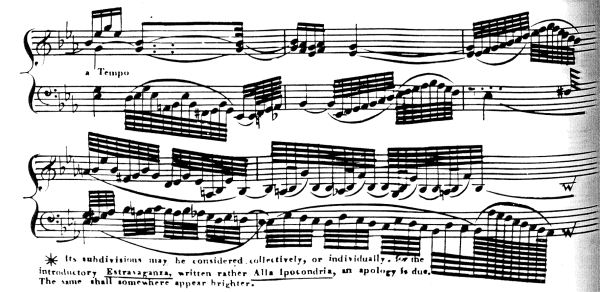
The process of slowing itself slowed slightly during the fifteenth, sixteenth, and seventeenth centuries. Faster notes continued to be introduced, but the fundamental tempos of music changed little. There are exceptions, and in some of these cases the slowness of the fundamental beat and the speed of the shortest notes produced dramatic effects: tuplet 128th notes appear in Beethoven’s third piano concerto, 256th notes in a concerto by Vivaldi (F. IV. n. 5), and most exceptionally, 1024th notes (incorrectly notated as 2048th notes) in the little known “Toccata Grande Cromatica” from The Sylviad by Anthony Phillip Heinrich (ca. 1825), a piece that in its own continual slowing of the fundamental beat is a microcosm of all of the notated music history of the West.[3] (See Example 1).


Example 1: Anthony Phillip Heinrich, “Toccata Grande Cromatica,” excerpt, with 512th and 1024th notes (incorrectly notated as 1024th and 2048th notes) at the end of the example.

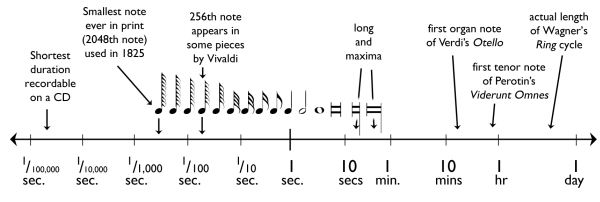
Between Perotin and Heinrich, there exists a range of time that is almost incomprehensible to our sense of how music unfolds. Within a single maxima, there are 1024 128th notes, and, as we have seen, even longer and shorter notes have occasionally been used. Example 2 shows (on a logarithmic scale) the amount of time various notes would take if they were all played at the same adagio tempo of one quarter note per second. Obviously it is absurd to use the entire range of note values in a single piece at a single tempo mark. In fact the pieces using the shortest notes tend to have the slowest tempos, and the contrary is true for pieces with the longest notes. But Figure 1 demonstrates the enormous pull towards expanding the range of rhythmic resources that composers have felt over the centuries.


Figure 1: Lengths of different note values at M.M. qtr. = 60.
(with actual CD frequency and Ring lengths for reference)


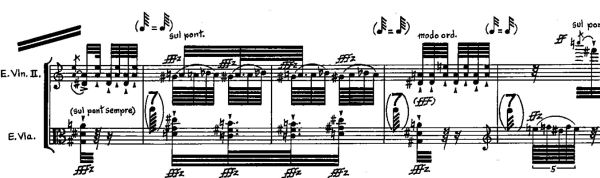
In contemporary art music, composers have played with all extremes of lengths, but the most significant innovations in notation have come, as they did in the Middle Ages and Renaissance, in the notation of the most fleeting notes.[4] One of the most interesting case studies in the continuation of the medieval tradition of shorter notes comes in the American composer George Crumb’s string quartet Black Angels (1970), where, in the excerpt shown in Example 2, he uses a time signature of 7/128 in measure 2--written with the denominator as a note--along with the almost as equally unusual 7/64 with each note receiving an equal accent, thus providing the shortest non-compound meter ever published.


Example 2: Unusually short beat values in George Crumb’s Black Angels.

Other unusual and brief meters appear occasionally in modern music. Karlheinz Stockhausen’s 1956 composition Zeitmaße uses meters that are nearly as short as Crumb’s, such as 2/32. Composers allied with the New Complexity school, including Brian Ferneyhough and Thomas Adès, have used meters such as 5/6 and 2/10 that allow “tuplet” values (in these cases, triplets and quintuplets) to be fundamental and independent units. Finally, though multiple simultaneous meters were used in the works of both Bach and Mozart, the metrical experiments of Conlon Nancarrow use multiple meters in ways that particularly stretch the definition of meter. His “Transcendental” Etude contrasts two canonic lines whose rhythms are in the ratio of the transcendental irrational numbers e to π.

I am particularly interested in these unusual ways of specifying beat and meter in today’s music because the same spirit of experimentation was at work throughout the Italian ars nova. The feeling that the resources of the past were insufficient to express the creative metrical impulses of the present dominated musical thought in the late Trecento and early Quattrocento. Over the next few blog posts I hope to show how.

Endnotes


[1] This post is adapted from part of an article "Changing Musical Time at
the Beginning of the Renaissance (and Today)" to be published by L. Olschki in an as-yet-unannounced surprise Festschrift in 2011. (Update 2026 - Joseph Connors Festschrift, available on trecento.com)

[2] On attempts to measure the slowing of medieval musical time in terms of clock time, see Marco Gozzi, “New Light on Italian Trecento Notation, part 1”, Recercare 13 (2001), pp. 5–78.

[3] The source for these (and many other) extremes of musical notation is Donald Byrd’s excellent on-line resource. I thank him for many stimulating conversations on this topic. The score of Example 1 has been republished recently as Anthony Phillip Heinrich, The Sylviad, or, Minstrelsy of Nature in the Wilds of North America: opus 3, intr. J. Bunker Clark, Greenleaf, Wis. 1996. The term chromatic in the title of the piece refers not to notes out of the key, but to the amount of ink (or color) needed to express the short notes in the work.

[4] On recent uses of extremely long durations in recent music see Alex Rehding, “The Discovery of Slowness in Music,” forthcoming.

30 March 2010

Cantus scriptus: Technologies of Medieval Song

guidonian handA two-day conference at University of Pennsylvania, November 19-20, 2010 will explore technology and medieval notation, both medieval notation as a technology in itself and new technologies used to study medieval musical manuscripts. I will be presenting on digital restorations, "bad" facsimiles (photos designed not to convey the look of the original, but instead facilitate further study), and how statistical models can help us estimate the number of French pieces of the late Middle Ages that once existed but now are lost.