Showing posts with label medieval music. Show all posts

09 December 2017

Correction: a missing footnote

In my article “Difference, Disability, and Composition in the Late Middle Ages: Of Antonio ‘Zachara’ da Teramo and Francesco ‘Il Cieco’ da Firenze,” chapter 26 in the Oxford Handbook of Music & Disability Studies, edited by Blake Howe, Stephanie Jensen-Moulton, Neil Lerner, and Joseph Straus, pp. 517–28, there is a discussion of Petrus frater dictus Palma ociosa, and how his “deformed hand” (Palma ociosa) may have impacted his perception as a singer and a teacher in light of the importance of the (Guidonian) Hand in instructing singing. In the context of a paragraph of original research, cited articles, and common knowledge not requiring a footnote, this discussion is none of the above. I should have cited Christopher Page, The “Summa musice”: a Thirteenth-Century Manual for Singers (Cambridge: CUP, 1991), which, as Daniel Leech-Wilkinson’s Grove article notes, is the place where this theory is discussed (pp. 72, 158, and lines 692–96).>

I regret the omission and ask Page’s forgiveness for the oversight.

17 September 2014

Recent Research

A few recent articles and software of interest and some older articles that might have been missed:

17 October 2013

Medieval Music, Digitally Reconstructed

In spring 2012, MIT established a new Center for Art, Science, and Technology (CAST) sponsored by a grant from the Mellon Foundation.  For the past year, CAST has been sponsoring wonderful concerts, shows, and exhibitions related to the now-fundamental interconnectivity between the creation and performance of art and the worlds of science, engineering, and technology. I'm proud to say that CAST's mandate also extends to the study of art, including music and musicology, and that they've chosen to feature my work in a great article, "Medieval Music, Digitally Reconstructed," written by Anya Ventura.  As always, I thank the NEH, Digging into Data partners, and the Seaver Institute, and MIT for their support of my work.


16 December 2012

Litany of Ars Nova (Trecento) Saints

Lord have mercy on us
Christ have mercy on us
Lord have mercy on us.

Accept holy Trinity
This joyful cry of peace
And remove the cloud
Of horrible schism.

Holy Hildegard
Mother of Musicians
Virgin Composer -- have mercy on us.

Holy Philippe de Vitry -- pray for us
Holy Marchetto of Padua -- pray for us
Holy Guillaume de Machaut -- pray for us
Holy Jacopo da Bologna -- pray for us
Holy Giovanni da Cascia -- pray for us
Holy Master Piero -- pray for us
Blessed Egidio and Guglielmo -- pray for us
Holy Francesco the Blind -- pray for us
Holy Lorenzo of Florence  -- pray for us
Holy Johannes Ciconia -- pray for us
Blessed Anthony, called Zachara of Teramo -- pray for us
Holy Matteo of Perugia -- pray for us
Holy Bartolino of Padua  -- pray for us
Blessed Solage  -- pray for us
Blessed Engardus -- pray for us
Holy Christine de Pizan -- pray for us
Blessed Alanus -- pray for us
Holy Baude Cordier -- pray for us
Blessed Oswald of Wolkenstein -- pray for us
Holy Prosdocimus of Beldemandis -- pray for us
All you holy composers, singers, and musicians -- pray for us
All you holy theorists and poets -- pray for us
All you scribes and compilers of manuscripts -- pray for us.

Blessed Françoise-Joseph Fétis -- pray for us
Blessed Johannes Wolf -- pray for us
Blessed Friedrich Ludwig  -- pray for us
Venerable Heinrich Besseler -- pray for us
Blessed Kurt von Fischer -- pray for us
Blessed Susanne Clercx -- pray for us
Holy Nino Pirrotta -- pray for us
Blessed Billy Jim Layton -- pray for us
Blessed Giuseppe Vecchi -- pray for us
Blessed Pierluigi Petrobelli -- pray for us
All you holy scholars -- pray for us
All you thinkers about medieval composers -- pray for us
All you translators of music theory -- pray for us
All you searchers of manuscripts and fragments -- pray for us.

Lord, be merciful,
From all dissonances -- Lord, save your people
From all scribal errors -- Lord, save your people
From your tritones -- Lord, save your people
From bad ficta choices -- Lord, save your people
From a sudden and unprovided hexachordal mutation -- Lord, save your people
From the scourge of lost manuscripts -- Lord, save your people
From incorrect prolation and mensuration -- Lord, save your people
From unexplained coloration -- Lord, save your people.

By the mystery of minim equivalence,
By your dragmas,
By your custodes, -- Lord, save your people
By your ligatures of perfection,
By your ligatures of propriety,
By your ligatures of opposite propriety, -- Lord, save your people
By your alteration and imperfection,
By your dots of division, and of addition,
By your chains of perfect semibreves under similis ante similis,
By your knowledge that what cannot be transcribed
    should not be transcribed, -- Lord, save your people
On the day of publication -- Lord save your people.

Be merciful to us scholars, -- Lord hear our prayer
That you will guide us,
That you will help us discern the alignment of voices,
Through the logic of perfect consonances on strong beats,
And not invent alternative explanations for simple transcriptions -- Lord hear our prayer
That you will grant us your Apel to discern your will, -- Lord hear our prayer
That it may please you to bring us to true transcription -- Lord hear our prayer
Guide and protect your holy universities,
Preserve in holy religion the editors at LIM, Brepols, AIM,
    and all those in holy publishing houses -- Lord hear our prayer
Humble the fifteenth-century scholars,
Who assert that only complete polyphonic Mass cycles are pleasing to you,
And those who transcribe fourteenth-century music
    without rhythmic reduction -- Lord hear our prayer
Bring back to the unity of performance those who sing without ficta,
    those who choose moribund tempos, and all those who play
    shawms without thought of intonation -- Lord hear our prayer
Strengthen and preserve us at Certaldo, and Dozza, and Novacella,
Raise our databases to the level of true understanding,
Reward all your servants with everlasting tenure -- Lord hear our prayer
Deliver our souls from indecipherable tropes, and the souls of those who transcribe ars subtillior,
    who search in archives, and read clerical shorthand -- Lord hear our prayer
Give and preserve the fragments not yet found,
Yield to us productivity in our sabbaticals,
Grant three beats of rest to all perfect semibreves pausae
Never causing our Finales or Sibeliuses to think of imperfecting them,
That it may please You to hear us and our editions,
    Jesus, Son of the Living God -- Lord hear our prayer

Lamb of God, who takes away the sins of transcription -- Spare us, O Lord!
Lamb of God, who takes away the sins of musicology -- Spare us, O Lord!
Lamb of God, who takes away the sins of scholarship -- Grant us thy peace.

Christ, hear us,
Lord Jesus, hear our prayer,
Lord, have mercy on us,
Christ, have mercy on us,
Lord, have mercy on us,

Amen.

09 July 2012

Fuga Trium Tempora from the Strasbourg Codex

[This is a draft “Working Paper” of research in progress; comments are welcome, but it should not be considered published work and may be removed before this is submitted for publication and replaced with a link to the published version.]

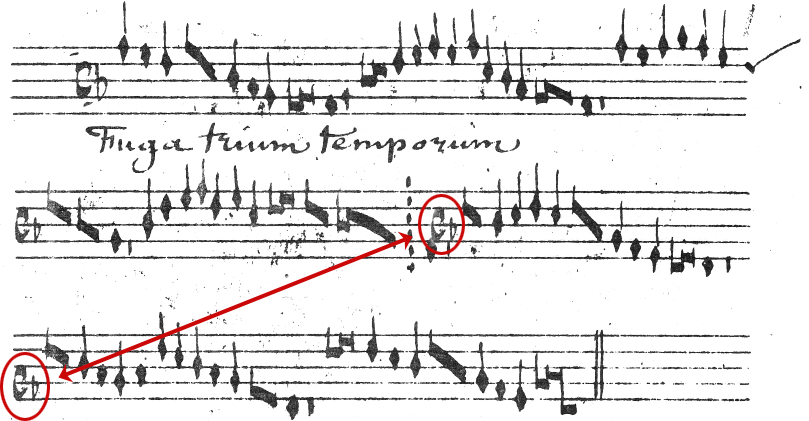
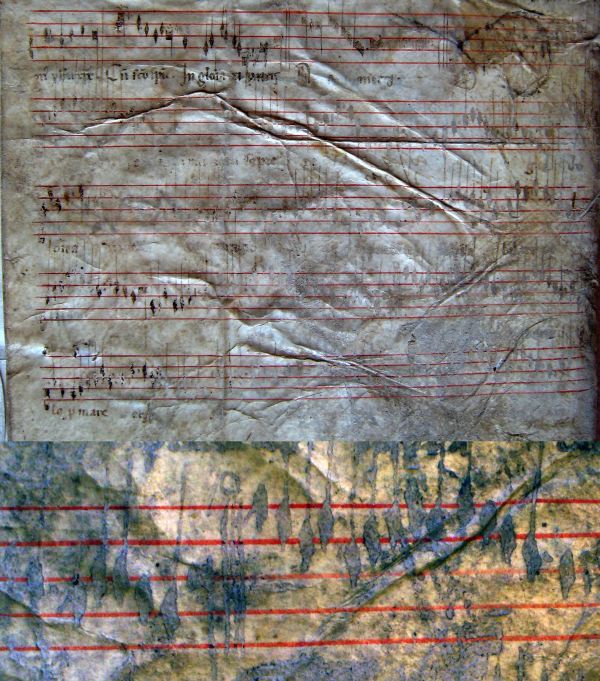
The manuscript, Strasbourg, Bibliothèque Municipale (olim Bibliothèque de la Ville), MS 222. C.22, was an extraordinary collection of music theory and secular and sacred music (sometimes in contrafact) from the first half of the fifteenth century.  In 1870, during the siege of Strasbourg in the Franco-Prussian war, the manuscript was destroyed.  Fortunately, portions of the manuscript survive in two important testimonies from before 1870: a short publication by Auguste Lippmann, “Essai sur un manuscrit du quinzième siècle decouvert dans la Bibliothèque de la ville de Strasbourg” Bulletins de la Société pour la Conservation des Monuments Historiques d'Alsace Serie 2.7 (1870), pp. 73–76, which reproduces a single page of the manuscript in facsimile (see Figure 1 below) and a partial copy of the manuscript made by Edmond de Coussemaker.  Coussemaker copied the table of contents, made an index with incipits, and transcribed some, but not all, of the pieces in the manuscript.  Coussemaker’s copy is now Brussels, Bibliothèque du Conservatoire Royal de Musique, MS 56.286 and has been published in facsimile in Albert van der Linden, editor, Le manuscrit musical M.222 C.22 de la Bibliothèque de Strasbourg: XVe siècle (Brussels: Office international de librairie, 1977). Many of the works in the manuscript can be identified through concordances in other manuscripts, though the process of finding concordances through incipits with contrafacted sacred texts has not always been easy.  Important work on the manuscript was conducted by Charles van den Borren (Le manuscrit musical M.222 C.22 de la Bibliothèque de Strasbourg (XVe siècle) brulé en 1870, et reconstitué d’après une copie partielle d’Edmond de Coussemaker [Antwerp: E. Secelle, 1924]) and in an excellent Habilitationschrift by Lorenz Welker (“Musik im Oberrhein im späten Mittelalter: Die Handschrift Strasbourg, olim Bibliothèque de la Ville, C.22” [Habilitationsschrift: Basel, 1993]).  Though most of the music that Coussemaker transcribed has appeared in modern editions, a few pieces have never been published in modern notation.

 Figure 1: Color image of folio 78v from the Strasbourg codex

One such neglected work was found on folio 38r (or perhaps 37v–38r, see Welker, “Folio-Synopse” p. 12) and transcribed on pp. 32–33 in Coussemaker’s edition.  It is a “Fuga trium temporum” whose top voices are attributed to J. de Climen and whose tenor is attributed to J. Cornelius (“Tenor J. Cornelii”).  The double attribution is unusual but as Virginia Newes notes, the tenor is inessential to the canon and could have been added later. (“Fuga and related contrapuntal procedures in European polyphony ca. 1350–ca. 1420,” [Ph.D. dissertation: Brandeis University, 1987], p. 403).  The description “Fuga trium temporum” implies a canon at the unison separated by three breves.  That the title appears under the top voice suggests that it is the top two voices which are in canon.  Though tenor canons are not unusual in the period and for much of the piece the tenor works in canon with itself at the distance of three breves, this effect is largely accounted for by the tenor’s need to support the upper-voice canon, and several cases of bare perfect fourths and long passages in parallel unisons strongly argues against an intention of four-voice performance (which is what Ensemble Leones, the only group I have found that has performed the piece, did in their reconstruction of “[Quatour voces in] fuga trium temporum”) or of one upper voice plus two tenor voices in canon (which would not fit the idea that J. Cornelius added an additional voice to an existing fuga).  Reproductions of Coussemaker’s transcription of the work are in Figures 2 and 3.


Figure 2: Top voice of J. de Climen, Fuga trium tempora.
 

Figure 3: Tenor by J. Cornelius of Fuga trium tempora.

The two-part form of the piece suggests that the work may have originally been a rondeau that no longer has a text (similar to Baude Cordier’s Tout par compas).  Less likely, the piece could have been a virelai or even a ballata (like Andrea da Firenze’s Dal traditor in the Squarcialupi codex), though the close spacing between entrances is more characteristic of French than Italian superius canons.  In any case, Charles van den Borren’s suggestion (p. 88) that the work could be an Italian caccia seems unlikely.

The work’s neglect in modern scholarship may be due to its lack of text, but is more likely attributable to the unsatisfactory nature of the piece which results when transcribed from Coussemaker’s edition.  Whether read as two upper voices without tenor, two upper voices with tenor, or a single upper voice, several problems emerge. The top voices have an unusual phrygian cadence.  The piece ends with a major third (C–E) between the top voice(s) and tenor: highly unlikely for the period.  Several intense dissonances appear in the second section that are out of style with the first. Parallel octaves, fifths, and unisons the tenor and the upper voices appear six times (10 if closely syncopated parallels are counted) in the second half; they are absent in either counting in the first half. Finally, the top voices have no motivic repetitions between the first and second sections.  Example 1 transcribes the ending as written.


Example 1: Ending of Fuga trium tempora as transcribed.

A small emendation to the piece, not previously explored, relieves all five of these problems.  After the first note of the second section, the top voice should be read a third higher than it is written.  Either the scribe of the Strasbourg codex or Coussemaker either wrote this section a third too high or he neglected to notice a change of clef for the second half of the piece.  A proposed emendation of the top voice is given in Figure 4.


Figure 4: Proposed emendation to Coussemaker’s transcription.

With this emendation, the second half of the top voice echoes many elements of the first half, all parallels are removed, the ranges of the first and second half become identical, and the piece ends with the upper voices on G supported by the C a perfect fifth below in the added tenor part.  (If the tenor was essential and conceived with the upper voices, we might expect the top voices to end on a high G with the D a fifth below with the tenor singing the G a fifth below.  The change in modal flavor added by the tenor is further evidence of it being a later addition).  The whole piece as I have transcribed it is given in Example 2 and, for the sake of understanding the piece better, a MIDI rendition as an .mp3 file is given in Example 3.  After the middle cadence, the second upper voice may rest or continue the canon from the first section; examples supporting both types of continuation are found in other pieces in Newes’s dissertation.


Example 2: Fuga trium temporum, new transcription.

Example 3: MIDI rendition.

The new transcription does nothing to explain who J. de Climen or Johannes Cornelius might be.  David Fallows has proposed that he might be the same as Jacobus de Clibano known from several compositions in the Aosta codex (“Jacobus de Clibano,” s.v. in The New Grove Dictionary of Music and Musicians, 2nd edition) or, less likely, he may be the same as Clement Liebert known from the piece Comment porray in the Strasbourg codex.  But neither this short contribution nor the musical style of Comment porray (though also in 2/4 but in white notation) give any aid in confirming or refuting this connection.  But I hope that the addition of a new contribution to the small repertory of fugae and canons of the early quattrocento can give a renewed urgency in discovering more about the identity of the composers of this finely crafted little work.

31 December 2010

Changing Musical Time in the Renaissance and Today

The concepts of time, rhythm, and musical notation have changed dramatically from the Middle Ages to the Present. Music has slowed dramatically over the past millennium, and composers have repeatedly taken advantage of new resources. This pre-print of a short paper in honor of Joseph Connors documents this change and shows how it can affect how we think of nearly every piece written from 1100 to today. It concludes with an in-depth discussion of a piece from a particularly important moment in the history of notation, the lauda, O Regina from the manuscript Siena, Archivio di Stato, Fondo Vicariato di Gavorrano (1568-69), Ravi 3, giving the first transcription of this work with its unique notation. (.pdf 600k)

Siena, Ravi 3 image

30 March 2010

Cantus scriptus: Technologies of Medieval Song

guidonian handA two-day conference at University of Pennsylvania, November 19-20, 2010 will explore technology and medieval notation, both medieval notation as a technology in itself and new technologies used to study medieval musical manuscripts. I will be presenting on digital restorations, "bad" facsimiles (photos designed not to convey the look of the original, but instead facilitate further study), and how statistical models can help us estimate the number of French pieces of the late Middle Ages that once existed but now are lost.