Showing posts with label canon. Show all posts

11 June 2014

The (other) Tournai Mass

[This is a draft “Working Paper” of research in progress; comments are welcome, but it should not be considered published work and may be removed before this is submitted for publication and replaced with a link to the published version.] 

The Tournai Mass is one of the oldest, if not the oldest, complete polyphonic Masses. It has been dated to around 1330 (though I'm inclined to find it a bit younger, perhaps 1350? but just on a hunch). It is contained in a magnificently interesting manuscript of chant from the fourteenth century now in the Belgium city of Tournai (Bibliothèque capitulaire, MS 476).

Like some other early Masses, such as the Machaut Mass, this is a six-section Mass with a concluding Ite Missa Est set as a motet. There are two other polyphonic works in the manuscript, placed within the Mass, a largely monophonic Sanctus with three-part "In excelsis" settings (PMFC 23, no. 72), directly after the first Sanctus, and a second Kyrie, placed after the Agnus Dei. The image from the bottom of folio 33r is below:


(image reproduced under the assumption of limited copyright of works over 100 years old and under the Fair Use principle of a small excerpt. I will happily remove this and the following excerpt under a request from the Tournai BC)

In Reaney's notes for RISM B/IV-2, he states that this work (#7) is, like the Sanctus (#5), an independent, polyphonic Mass section and transcribes the incipit as such:


Cattin and Facchin in their monumental edition of French (& Spanish, Polish, Dutch, ... everything but Italian and English) Mass movements transcribed it as monophonic and noted that:
The well known melody...occurs in the T[enor] range in the Tournai MS; the question therefore remains whether one or more voices would have accompanied it. For this reason we decided to include this purely monodic piece in the present edition.
The opening of their transcription is shown below:

There are a few errors in this section of the transcription: the second Kyrie has three missing notes, and an incorrectly transcribed C instead of D. Together these errors account for the different lengths and incompatible harmony of the first Kyrie if the work were to be transcribed polyphonically, as I will propose below. There are a few length errors in the third Kyrie which also could have made a polyphonic transcription difficult. However it is the Christe section that I am sure made great editors who had 130+ mass movements give up on making a polyphonic 3-fold Kyrie and instead make a monophonic 9-fold Kyrie. The three Christe sections seem to begin on the notes A, G, and A and end on A, E, B; even if the first part is started after a breve rest (which may be interpreted as a sectional divider instead), the lengths and sonorities of this section just do not add up.

The solution comes from believing that the scribe himself did not realize where the different voices began and chose to ligate the final note of the first voice with the first note of the second voice.

Beginning the second part on the second note of the ligature and ending the first voice on the first part gives a fully satisfying polyphonic version of the whole Kyrie:


A mediocre, generated .mp3 giving some sense of the piece is given below.


With these adjustments, the piece is almost entirely consonant, with the following breakdown of sonorities (discounting triplets in the middle of a semibreve):

36%  Perfect fifth
18   Major triad
12   Major third
12   Minor triad
 9   Minor third
 8   Minor triad as 6-3
 3   Major sixth
 2   Minor sixth
 0.5 Perfect fourth

(Numbers do not add up to 100% because of rounding)

Cattin and Facchin note that piece seems to be on the chant cantus firmus of no. 58 of Margaretha Landwehr-Melnicki's catalogue. The first Kyrie is indeed similar to this chant, but as a look at Paris, BNF lat. 14819, f. 34v. or Paris, BNF lat. 17309, f. 27v will show, the rest of the work is unrelated to this chant.

Otherwise the style of the work is similar to many French works from around 1350 (and also Spanish and Italian works from this time or slightly later). Facchin's description of these pieces, largely homophonic but with decorations, as part of a Wandering Style, or Stile Vaganti! seems quite appropriate for this work that wandered around the foot of a more famous Mass, waiting to be rediscovered.

More about the Sanctus and a fuller realization of it to come soon, thanks to an idea from Jan Janovčik. Here's a preview of his great recording with his Cantores Sancti Gregorii


Thanks to Jan Janovčik, Rob C. Wegman, and Dominique Gatté for aid and suggesting the Tournai manuscript as a source worth returning to. And to Anna Grau and Jeremy Jennings for their work on the EMMSAP project that made this work quickly possible.

09 July 2012

Fuga Trium Tempora from the Strasbourg Codex

[This is a draft “Working Paper” of research in progress; comments are welcome, but it should not be considered published work and may be removed before this is submitted for publication and replaced with a link to the published version.]

The manuscript, Strasbourg, Bibliothèque Municipale (olim Bibliothèque de la Ville), MS 222. C.22, was an extraordinary collection of music theory and secular and sacred music (sometimes in contrafact) from the first half of the fifteenth century.  In 1870, during the siege of Strasbourg in the Franco-Prussian war, the manuscript was destroyed.  Fortunately, portions of the manuscript survive in two important testimonies from before 1870: a short publication by Auguste Lippmann, “Essai sur un manuscrit du quinzième siècle decouvert dans la Bibliothèque de la ville de Strasbourg” Bulletins de la Société pour la Conservation des Monuments Historiques d'Alsace Serie 2.7 (1870), pp. 73–76, which reproduces a single page of the manuscript in facsimile (see Figure 1 below) and a partial copy of the manuscript made by Edmond de Coussemaker.  Coussemaker copied the table of contents, made an index with incipits, and transcribed some, but not all, of the pieces in the manuscript.  Coussemaker’s copy is now Brussels, Bibliothèque du Conservatoire Royal de Musique, MS 56.286 and has been published in facsimile in Albert van der Linden, editor, Le manuscrit musical M.222 C.22 de la Bibliothèque de Strasbourg: XVe siècle (Brussels: Office international de librairie, 1977). Many of the works in the manuscript can be identified through concordances in other manuscripts, though the process of finding concordances through incipits with contrafacted sacred texts has not always been easy.  Important work on the manuscript was conducted by Charles van den Borren (Le manuscrit musical M.222 C.22 de la Bibliothèque de Strasbourg (XVe siècle) brulé en 1870, et reconstitué d’après une copie partielle d’Edmond de Coussemaker [Antwerp: E. Secelle, 1924]) and in an excellent Habilitationschrift by Lorenz Welker (“Musik im Oberrhein im späten Mittelalter: Die Handschrift Strasbourg, olim Bibliothèque de la Ville, C.22” [Habilitationsschrift: Basel, 1993]).  Though most of the music that Coussemaker transcribed has appeared in modern editions, a few pieces have never been published in modern notation.

 Figure 1: Color image of folio 78v from the Strasbourg codex

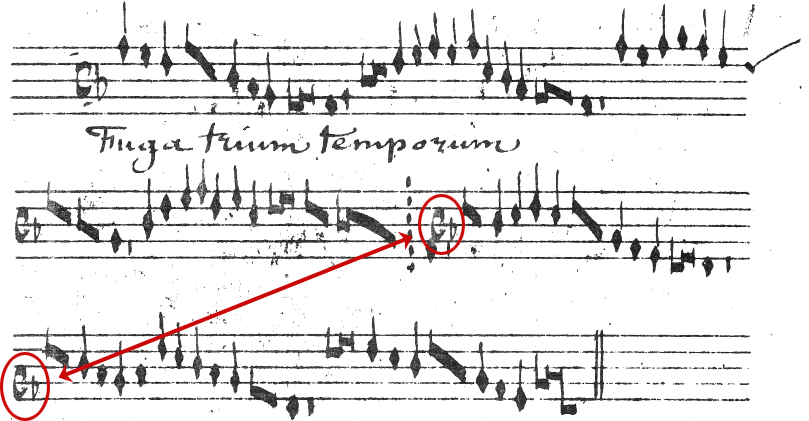
One such neglected work was found on folio 38r (or perhaps 37v–38r, see Welker, “Folio-Synopse” p. 12) and transcribed on pp. 32–33 in Coussemaker’s edition.  It is a “Fuga trium temporum” whose top voices are attributed to J. de Climen and whose tenor is attributed to J. Cornelius (“Tenor J. Cornelii”).  The double attribution is unusual but as Virginia Newes notes, the tenor is inessential to the canon and could have been added later. (“Fuga and related contrapuntal procedures in European polyphony ca. 1350–ca. 1420,” [Ph.D. dissertation: Brandeis University, 1987], p. 403).  The description “Fuga trium temporum” implies a canon at the unison separated by three breves.  That the title appears under the top voice suggests that it is the top two voices which are in canon.  Though tenor canons are not unusual in the period and for much of the piece the tenor works in canon with itself at the distance of three breves, this effect is largely accounted for by the tenor’s need to support the upper-voice canon, and several cases of bare perfect fourths and long passages in parallel unisons strongly argues against an intention of four-voice performance (which is what Ensemble Leones, the only group I have found that has performed the piece, did in their reconstruction of “[Quatour voces in] fuga trium temporum”) or of one upper voice plus two tenor voices in canon (which would not fit the idea that J. Cornelius added an additional voice to an existing fuga).  Reproductions of Coussemaker’s transcription of the work are in Figures 2 and 3.


Figure 2: Top voice of J. de Climen, Fuga trium tempora.
 

Figure 3: Tenor by J. Cornelius of Fuga trium tempora.

The two-part form of the piece suggests that the work may have originally been a rondeau that no longer has a text (similar to Baude Cordier’s Tout par compas).  Less likely, the piece could have been a virelai or even a ballata (like Andrea da Firenze’s Dal traditor in the Squarcialupi codex), though the close spacing between entrances is more characteristic of French than Italian superius canons.  In any case, Charles van den Borren’s suggestion (p. 88) that the work could be an Italian caccia seems unlikely.

The work’s neglect in modern scholarship may be due to its lack of text, but is more likely attributable to the unsatisfactory nature of the piece which results when transcribed from Coussemaker’s edition.  Whether read as two upper voices without tenor, two upper voices with tenor, or a single upper voice, several problems emerge. The top voices have an unusual phrygian cadence.  The piece ends with a major third (C–E) between the top voice(s) and tenor: highly unlikely for the period.  Several intense dissonances appear in the second section that are out of style with the first. Parallel octaves, fifths, and unisons the tenor and the upper voices appear six times (10 if closely syncopated parallels are counted) in the second half; they are absent in either counting in the first half. Finally, the top voices have no motivic repetitions between the first and second sections.  Example 1 transcribes the ending as written.


Example 1: Ending of Fuga trium tempora as transcribed.

A small emendation to the piece, not previously explored, relieves all five of these problems.  After the first note of the second section, the top voice should be read a third higher than it is written.  Either the scribe of the Strasbourg codex or Coussemaker either wrote this section a third too high or he neglected to notice a change of clef for the second half of the piece.  A proposed emendation of the top voice is given in Figure 4.


Figure 4: Proposed emendation to Coussemaker’s transcription.

With this emendation, the second half of the top voice echoes many elements of the first half, all parallels are removed, the ranges of the first and second half become identical, and the piece ends with the upper voices on G supported by the C a perfect fifth below in the added tenor part.  (If the tenor was essential and conceived with the upper voices, we might expect the top voices to end on a high G with the D a fifth below with the tenor singing the G a fifth below.  The change in modal flavor added by the tenor is further evidence of it being a later addition).  The whole piece as I have transcribed it is given in Example 2 and, for the sake of understanding the piece better, a MIDI rendition as an .mp3 file is given in Example 3.  After the middle cadence, the second upper voice may rest or continue the canon from the first section; examples supporting both types of continuation are found in other pieces in Newes’s dissertation.


Example 2: Fuga trium temporum, new transcription.

Example 3: MIDI rendition.

The new transcription does nothing to explain who J. de Climen or Johannes Cornelius might be.  David Fallows has proposed that he might be the same as Jacobus de Clibano known from several compositions in the Aosta codex (“Jacobus de Clibano,” s.v. in The New Grove Dictionary of Music and Musicians, 2nd edition) or, less likely, he may be the same as Clement Liebert known from the piece Comment porray in the Strasbourg codex.  But neither this short contribution nor the musical style of Comment porray (though also in 2/4 but in white notation) give any aid in confirming or refuting this connection.  But I hope that the addition of a new contribution to the small repertory of fugae and canons of the early quattrocento can give a renewed urgency in discovering more about the identity of the composers of this finely crafted little work.